Rack feed / tap-off rating
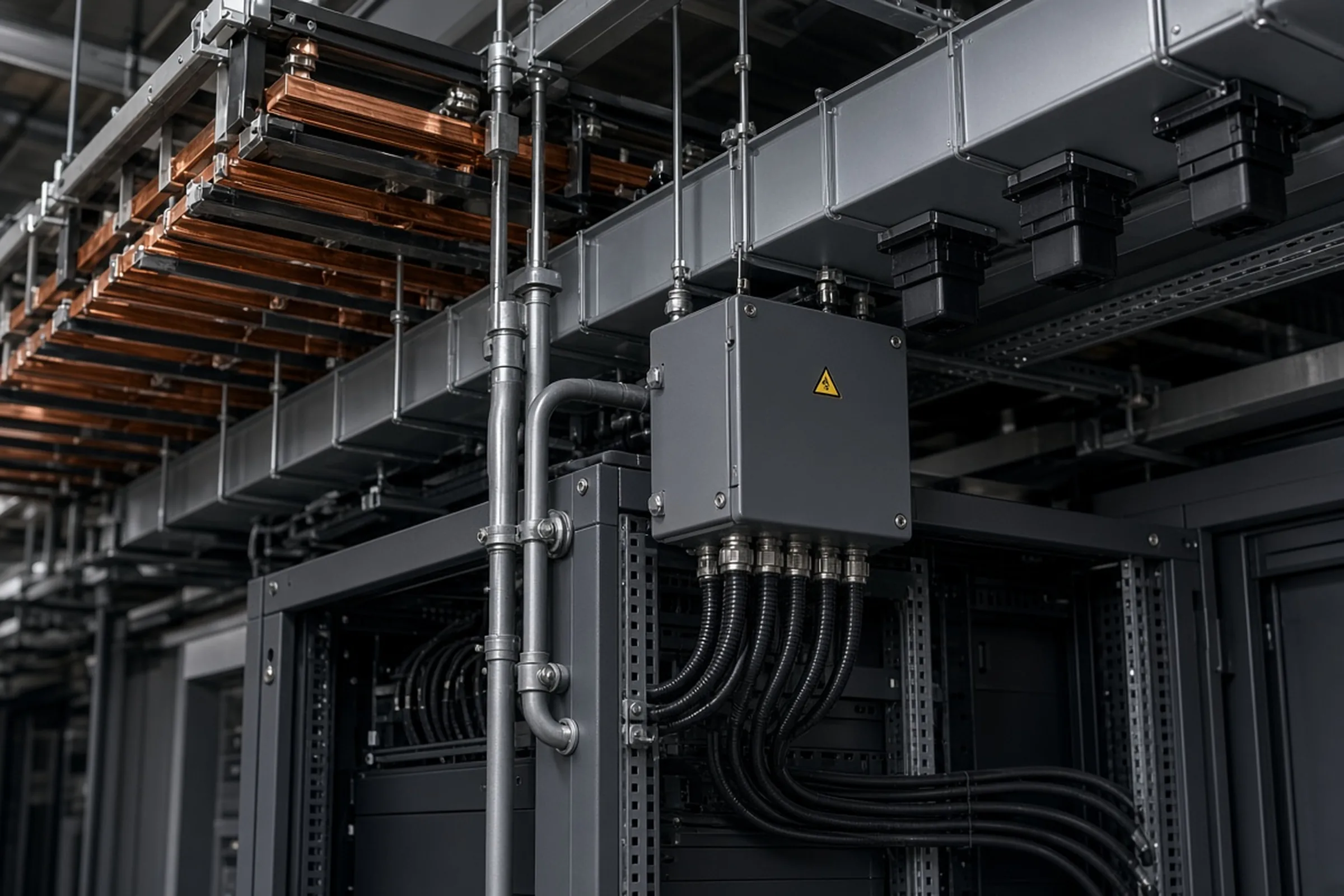
The commonest hard stop in a legacy hall is the last two metres of copper.
What runs out
The continuous current a single rack position can be fed at, set by the tap-off unit on the busway and the flexible cord to the rack PDU.
The relation that governs it
I = P / (√3 · V · pf). A 132 kW rack at 400 V three-phase and pf 0.95 draws on the order of 200 A per feed. A hall built for 8 kW racks is typically fitted with 32–63 A tap-offs.
Worked example
What current does one NVIDIA GB300 NVL72 rack draw at 400 V?
135 kW / (1.73 × 400 V × 0.95)
205 A per rack
A 63 A tap-off feeds a third of one rack.
Reproducible by hand. A page that asks you to trust a number has taught you nothing.
How to tell whether it binds in your hall
Divide your target rack power by (1.73 × your busway voltage × 0.95). If the answer exceeds the rating stamped on your installed tap-off units, this binds before anything else does — and it binds at rack one, not at scale.
What relieves it
Higher-rated tap-off units, and the busway itself where its ampacity does not allow them. Usually the cheapest rung on the ladder in euros and one of the faster ones in weeks.
What that relief costs beyond money
Tap-off units have been a reported shortage item. Installation onto an energised busway is possible with some systems and not others; where it is not, the outage per run is a commercial cost in an occupied hall.
Indicative relief lead time
12–40 weeks
European retrofits. The schedule, not the capex, usually decides.
How we currently price this relief
E0
A placeholder with a −50%/+100% band, not a price. It is replaced by a quotation the first time we tender this relief on a real project.
The mistake we actually see
Operators quote the hall's total kW and conclude they have headroom. Total capacity says nothing about whether one position can be fed.
Basis
- — Uptime Intelligence — at high density, power distribution creates issues more often than cooling.
These usually travel together
Does this one bind in your hall?
Seven numbers you already know, all thirteen constraints evaluated, and the one that stops you first named with its basis in engineering units. Free.