Busway ampacity
A 400 A busway run cannot feed three 130 kW racks, whatever the hall total says.
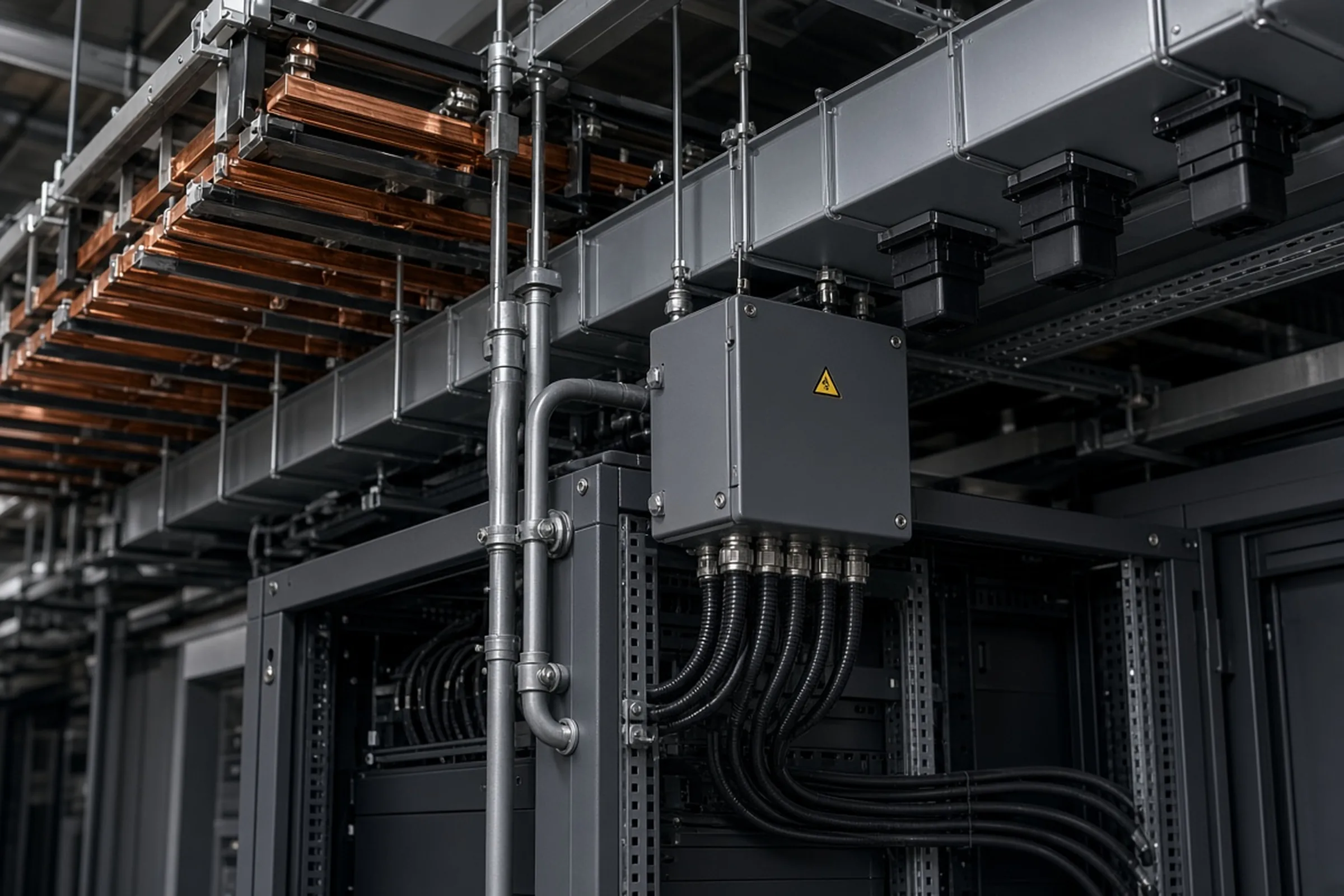
What runs out
The continuous current a busway run carries, derated for ambient, grouping and the site's own continuous-load policy.
The relation that governs it
Racks per run = (ampacity × utilisation limit × √3 × V × pf) / rack power. At 400 A, 0.8 continuous limit, 400 V and pf 0.95, a run supports roughly 210 kW — about 1.6 racks of a 132 kW platform.
Worked example
How many racks does a 400 A busway run carry?
400 A × 0.8 × 1.73 × 400 V × 0.95 = 211 kW; 211 / 135
1.6 racks per run
Modern AI halls specify 800–1000 A for this reason.
Reproducible by hand. A page that asks you to trust a number has taught you nothing.
How to tell whether it binds in your hall
Take your installed ampacity per run, multiply by your continuous-load derating (often 0.8), and convert to kW. Divide by your target rack power. If that number is smaller than the racks you want per run, this binds. Legacy halls commonly run 400 A; modern AI halls specify 800–1000 A.
What relieves it
Replace the busway with a higher ampacity, or add further runs where riser and routing space exists. Adding runs is usually cheaper and slower than it sounds, because the constraint moves upstream to the panel.
What that relief costs beyond money
Replacement is invasive in an occupied hall and is normally phased run by run. Adding runs needs riser space that a 2014 building may not have.
Indicative relief lead time
16–44 weeks
European retrofits. The schedule, not the capex, usually decides.
How we currently price this relief
E0
A placeholder with a −50%/+100% band, not a price. It is replaced by a quotation the first time we tender this relief on a real project.
The mistake we actually see
Ampacity is often read as a nameplate rather than a continuous rating. The derated figure is the one that decides.
Basis
- — IEC 61439-6 busbar trunking systems; site continuous-load policy.
These usually travel together
Does this one bind in your hall?
Seven numbers you already know, all thirteen constraints evaluated, and the one that stops you first named with its basis in engineering units. Free.