PILOT-STAGE · FOUNDER-LED · PHYSICS-INFORMED

The bottleneck
isn't chips.
It's power.

Independent engineering for behind-the-meter generation, DC distribution, and physics-informed EMS — so your compute schedule stops waiting on the grid.

Start with a Power Audit. You get a real engineer's read on your site, not a sales deck.

See the architectures
FIG. 01 — TIME TO POWER
Application → energized · drag the knobs to model your site
012345678
Grid interconnection queuewait on the utility
energized · year 6
On-site behind-the-meterGridForge approach
energized · month 18
4.5 yrs recoveredYEARS FROM APPLICATION →
First-power value unlocked
$900M
100 MW · $2.0M/MW-yr · 4.5 yrs sooner
Cost of waiting
$548k/ day
every day in the queue
Planning estimate on your inputs — value = capacity × revenue/MW-yr × years recovered. Queue, timeline and revenue are editable assumptions, not guarantees. A Power Audit replaces them with your site's real numbers.
THE MARKET YOU'RE ALREADY OPERATING IN
68 GW
Global AI data-center power demand by 2027
RAND, 2025
~2,600 GW
Capacity stuck in US interconnection queues
FERC / LBNL, 2025
5–8 yrs
Typical grid interconnection wait in key US markets
FERC / PJM, 2025
18–24 mo
On-site behind-the-meter power can deploy in
Industry, 2026
THE #1 BOTTLENECK IN AI

Grid queues are setting your
deployment timeline.

A data center can be built in two to three years — but it's inert until it can draw power. In constrained markets, that's the binding constraint on the whole roadmap.

The queue

Roughly 2,600 GW of generation sits in US interconnection queues — more than the entire installed US grid. Average waits in key markets now run 5 to 8 years from application to energized.

FERC / LBNL, 2025
The cost of waiting

A data center can be built in two to three years — but it is useless until it can draw power. The IEA estimates ~20% of planned data-center projects globally face significant grid-driven delays.

IEA Energy & AI, 2025
The shift

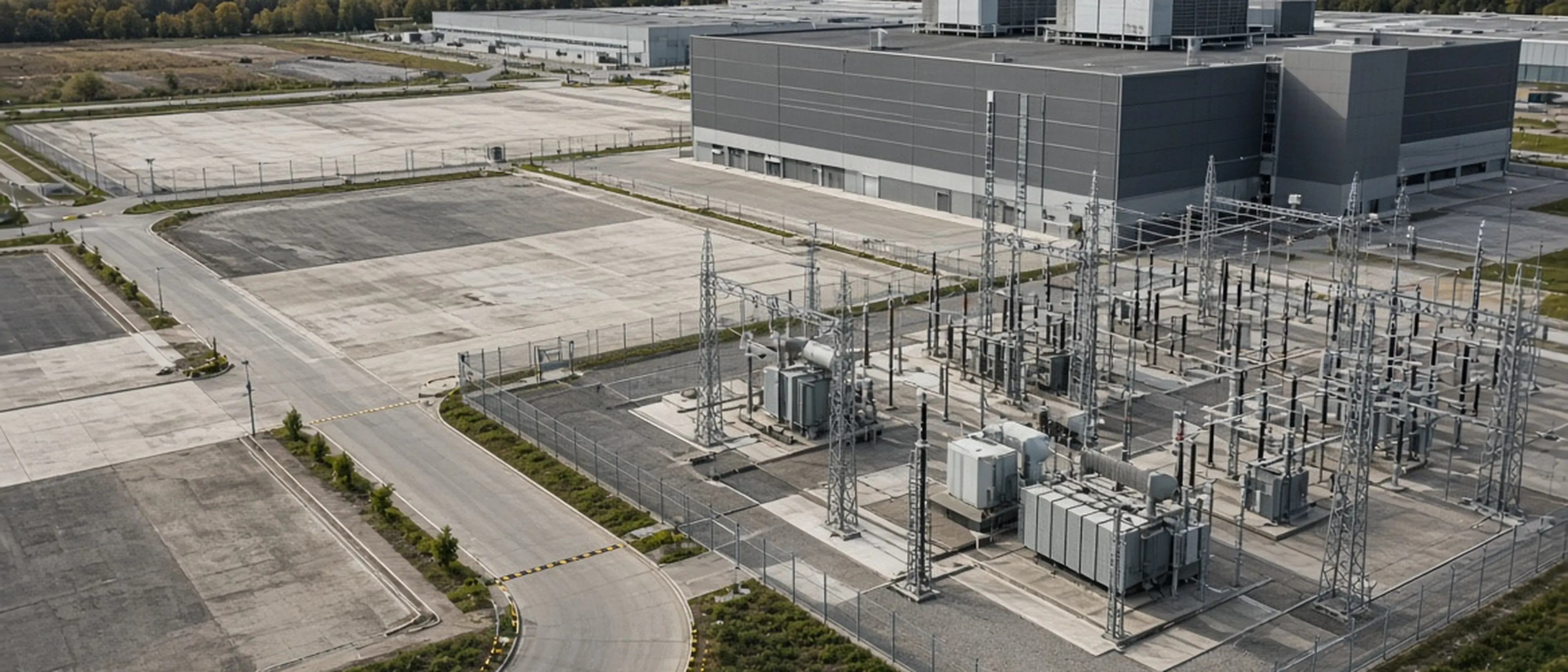
Developers are moving behind-the-meter: on-site gas, hybrid storage, and co-location with generation can energize a site in 18–24 months instead of waiting on the queue.

Industry analysis, 2026
REAL DATA, NOT A MOCKUP

The market proves the thesis daily.

This pulls the live EPEX day-ahead curve for the German grid. The volatility you see is the whole reason on-site storage and firm behind-the-meter power pencil out — and it's fetched live, not illustrated.

LIVE GRID CONSOLE · GERMANY (DE-LU)

The grid, streaming in real time.

CONNECTING…
Connecting to live grid feeds…
Loading today's real price curve…
HOW WE ENGAGE

From a site to a plan you can fund.

01

Audit the site

Load profile, interconnection status, and behind-the-meter options. A defensible go / no-go in days, not months.

02

Engineer the system

Feasibility, financial model, and a ready-to-permit integration design — sized from your real load, not a rule of thumb.

03

Commission & tune

Support through commissioning, then tune the EMS against live telemetry so peak shaving is real, not theoretical.

QUANTIFY THE GAP

What is the queue costing you?

The hero shows the gap. This puts a number on it for your project — cluster size, your market's interconnection wait, and what a megawatt of online compute is worth to you.

FIG. 01B — TIME-TO-POWER, YOUR PROJECT

Put your numbers in.

PLANNING MODEL
Grid interconnection queuewait on the utility
energized · month 72
On-site behind-the-meterGridForge approach
energized · month 18
MONTHS FROM APPLICATION →
4.5 yrs
Compute online sooner (54 months recovered)
€504.0M
Revenue-at-risk of waiting on the queue

Revenue assumption is editable (Derived from public hyperscale colo lease ranges, 2025). On-site figure is a planning timeline, not a guarantee — a Power Audit replaces it with a defensible date for your site.

SEE THE PHYSICS

Most power engineers model a flat load.

AI training doesn't draw flat. Checkpoints and all-reduce steps slam the cluster with sharp, sub-second transients. Size your firm generation for those peaks and you overbuild; ignore them and you brown out. The battery is what catches the spike — here's the stack doing it, live.

FIG. 02 — EMS LOAD MONITOR

Spiky AI load, served by the stack

Real-time, on your clock. Watch the stack catch each event.

LIVE · --:--:--REAL-TIME SIM · MODELED WAVEFORM
BESS · sub-secondFuel cell · ~12s rampGas baseloadRenewablesGPU load

Large-scale pretraining synchronizes thousands of GPUs and runs around the clock. Checkpoints and all-reduce steps cause sharp, collective power swings — but the daily average barely moves: training doesn't care what time it is. — shape from Meta/LLNL training-load studies, 2024–2025.

20.8 MW
Peak transient the battery absorbs
33%
Firm capacity not sized for
<1s vs ~12s
BESS response vs fuel-cell ramp
fetching live price…

The clock and the EPEX price are live; the load waveform is a model — no operator publishes live GPU telemetry, so on a real deployment this monitor streams your cluster's actual data instead.

WHAT YOU CAN BUY TODAY

Engineering services, fixed scope.

Real deliverables a senior power-systems engineer produces for your specific site. This is where engagements start.

START HERE

Power Audit & Site Assessment

Behind-the-meter feasibility, load profiling, interconnection-status review, and risk modeling for a candidate site. A clear, evidence-based go / no-go.

YOU RECEIVE
Go / no-go decision + preliminary sizing
TIMELINE
10–14 days

Feasibility Study & Financial Model

LCOE, IRR, and sensitivity analysis across fuel, storage, and incentive scenarios. Built to survive an investment committee, not a pitch deck.

YOU RECEIVE
Bankable financial model + offtake options
TIMELINE
3–5 weeks

Integration Design & Engineering

Single-line diagrams, protection coordination, EMS architecture, and vendor selection for a hybrid behind-the-meter system. Ready to hand to an EPC.

YOU RECEIVE
Ready-to-permit design package
TIMELINE
Scoped per site

Commissioning & EMS Tuning

On-site or remote commissioning support, performance validation, and tuning of the predictive control layer against real load telemetry.

YOU RECEIVE
Validated performance + tuned controls
TIMELINE
Engagement-based
THE PIPELINE, STEP BY STEP

What actually happens when load spikes.

Behind-the-meter only works if the system handles the sharp, sub-second transients of AI training. Here's the exact sequence — play it, or step through it yourself.

SEQUENCE OF EVENTS · FULL OPERATING ENVELOPE

How the system catches a spike — and everything after.

step 1 / 12
GridSTANDBYGas baseloadFuel cellBESSEMSPHYSICS-INFORMEDDC busGPU racks
Baseline

Steady state. Gas baseload and the fuel cell serve the cluster entirely behind the meter. The grid sits in standby — no queue, no multi-year wait.

Steps 1–6: spike response · Steps 7–12: redundancy, islanding, grid services, scale, decarbonization, governance

REFERENCE ARCHITECTURES

The systems we design,
drawn to first principles.

Validated engineering reference designs — the depth behind the services.

REFERENCE DESIGNS — NOT DELIVERED CUSTOMER PROJECTS
REF-01Gas / fuel-cell + BESS + on-site renewables

Hybrid Behind-the-Meter Microgrid

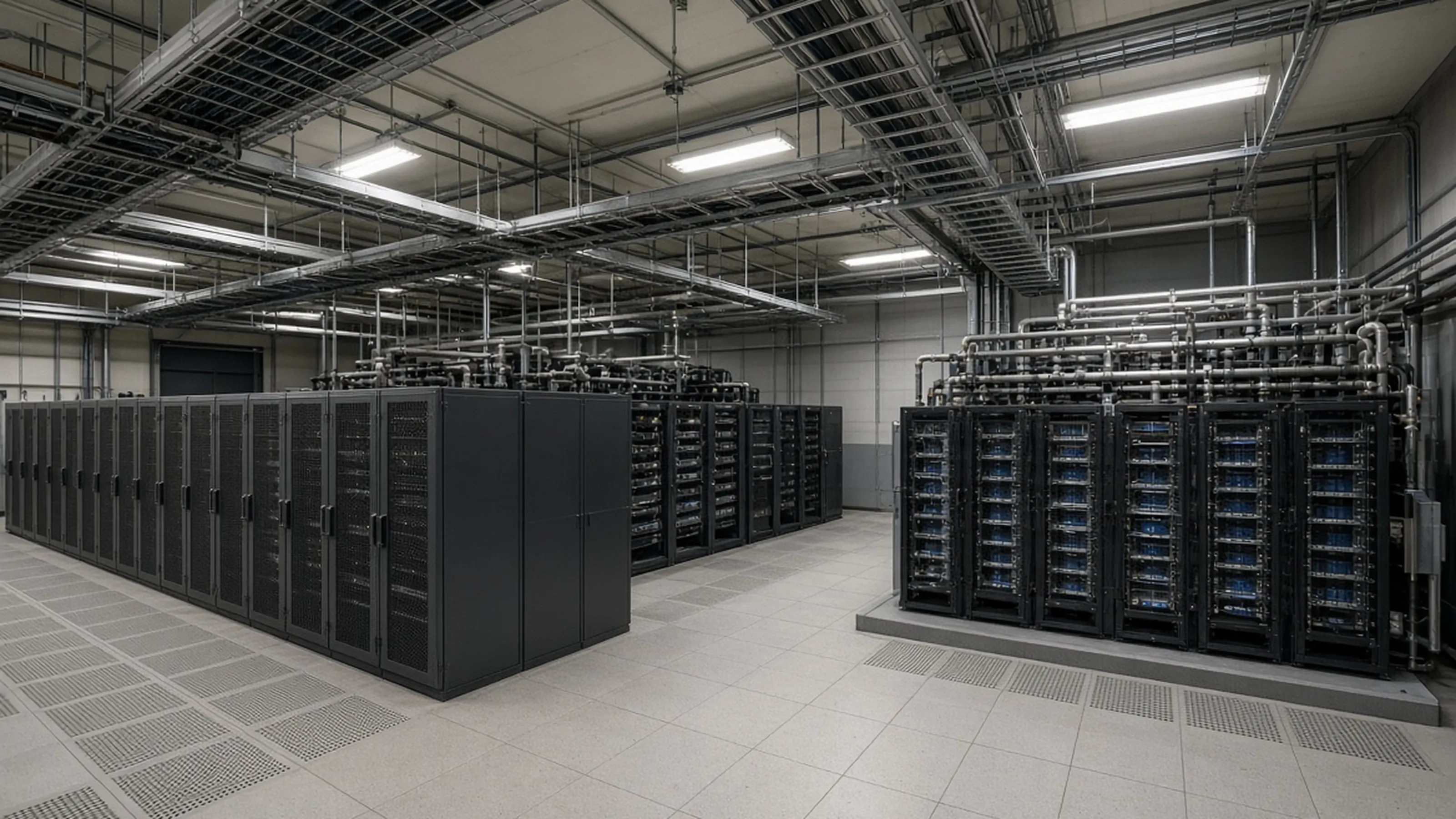
Containerized, skid-mounted hybrid topology with DC-native coupling, sized for spiky GPU training loads up to ~120 MW per site. N+1 redundancy and bidirectional flow built in.

Bypasses multi-year interconnection queues
Fuel-flexible, phased-capacity design
Sized from a real load profile, not a rule of thumb
REF-02400–800 V DC bus · direct-to-rack

High-Voltage DC Distribution

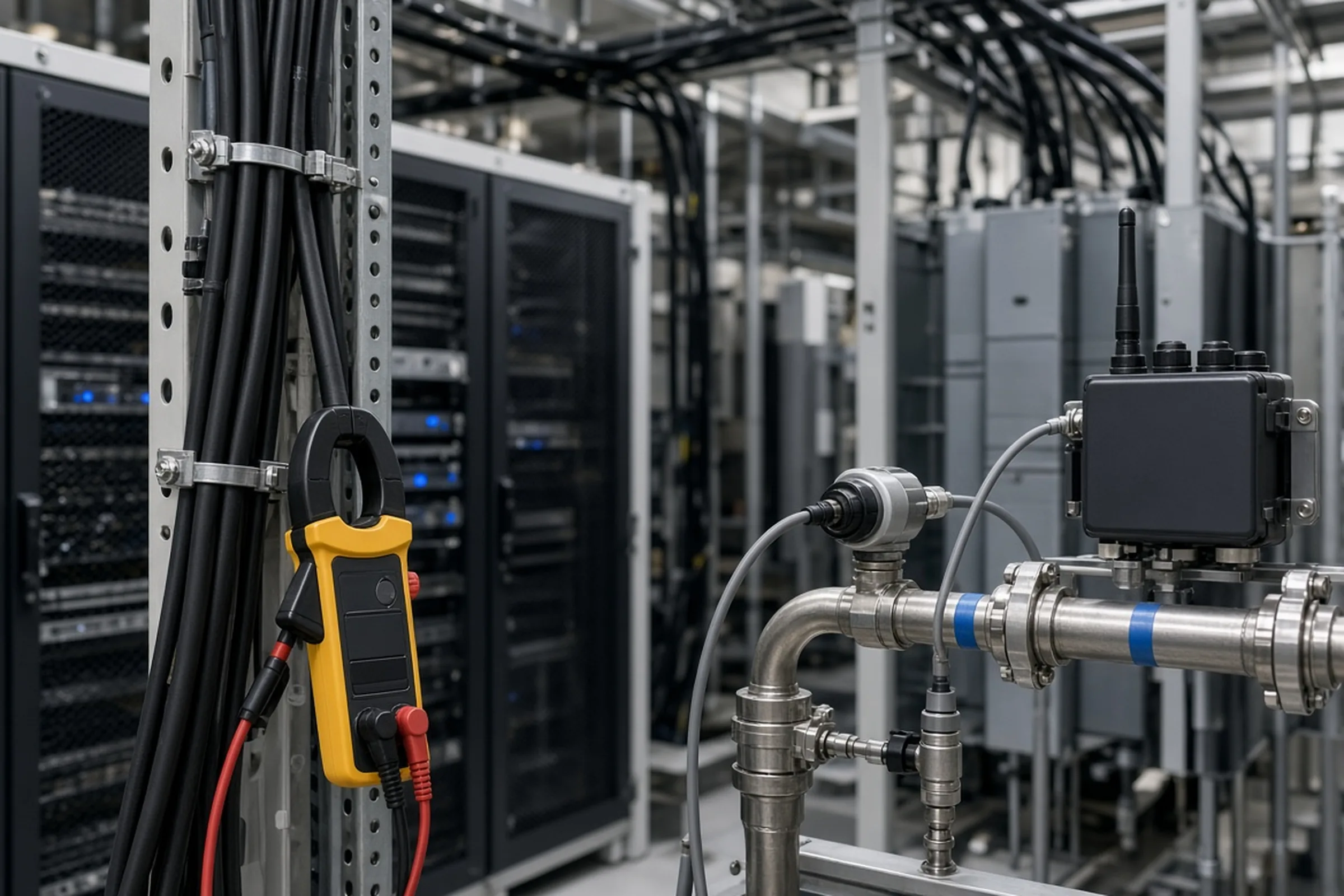
DC distribution architecture for GPU-dense clusters that removes AC↔DC conversion stages and exposes per-rack power telemetry, with hot-swap modular PDUs.

Cuts conversion-stage losses
Native 48 V–800 V rack compatibility
Per-rack power visibility for the EMS
REF-03Predictive control for spiky loads

Physics-Informed EMS

A deterministic control layer that forecasts training / inference spikes from telemetry and physics, optimizing charge/discharge and enabling peak shaving — designed to integrate with existing BMS and grid EMS.

Predictive peak shaving, not reactive
Second-life BESS integration support
API-first for orchestration
MATCH A DESIGN TO YOUR SITE

Which reference fits your build?

Dial in your target capacity and firm/renewable balance. It maps you to a reference variant with an honest first-power timeline and a phasing plan — a starting point for the conversation, not a quote.

FIG. 03 — CONFIGURE A REFERENCE SYSTEM

Size it for your site.

INDICATIVE PLANNING OUTPUT
Fuel preference
REF-01-MRECOMMENDED
Containerized · 40–120 MW
First power
~18 months
Phasing
2 × ~40 MW phases
Firm mix
~80% firm (balanced gas + fuel cell) · ~20% renewable + BESS for transients
Topology
Gas + fuel-cell firming + BESS + renewables

Phased containerized build; capacity tracks the cluster ramp. Capacity is phased so capex tracks the cluster ramp. Indicative only — a Feasibility Study produces the bankable sizing and economics.

Variant selected by capacity envelope; mix adapts to your inputs.

THE REFERENCE ARCHITECTURE, IN DETAIL

What the internal power system actually looks like.

Past the marketing: a real single-line diagram of a behind-the-meter facility — grid, metering boundary, switchboard, UPS, distribution, and the on-site generation and storage that keep the racks fed. Click through it.

FIG. 04 — REFERENCE SINGLE-LINE DIAGRAM

Watch the power flow, grid to GPU.

A 100 MW-class facility told in twelve stages — from grid intake to live EMS orchestration. Press play, step through, or click any block.

ILLUSTRATIVE · INDICATIVE RATINGS
TSO-VISIBLEBEHIND THE METER — NOT VISIBLE TO TSO IN REAL TIMEPOIGrid230 kVMSBmain busAC UPSconditioningIT racks480V → GPUsCooling30–40% loadGensetscontainerizedBESScontainerizedOn-site PVbehind-meterHV/MVMV/LV
THE PATHSCENE 1 / 12Grid intake
230 kV
Voltage / path
~100 MW
Power (indicative)
~260 A
Current (illustrative)

Utility power crosses the POI — the metered boundary. Everything to the right is invisible to the TSO in real time.

ACT I · THE PATH (1–6)ACT II · IN OPERATION (7–12)
PHYSICAL BUILDING BLOCKS
Containerized BESS
Li-ion racks in a 20–40 ft container
Genset skid
Gas / diesel, containerized
Racked compute hall
GPU racks + PDUs
Outdoor MV skid
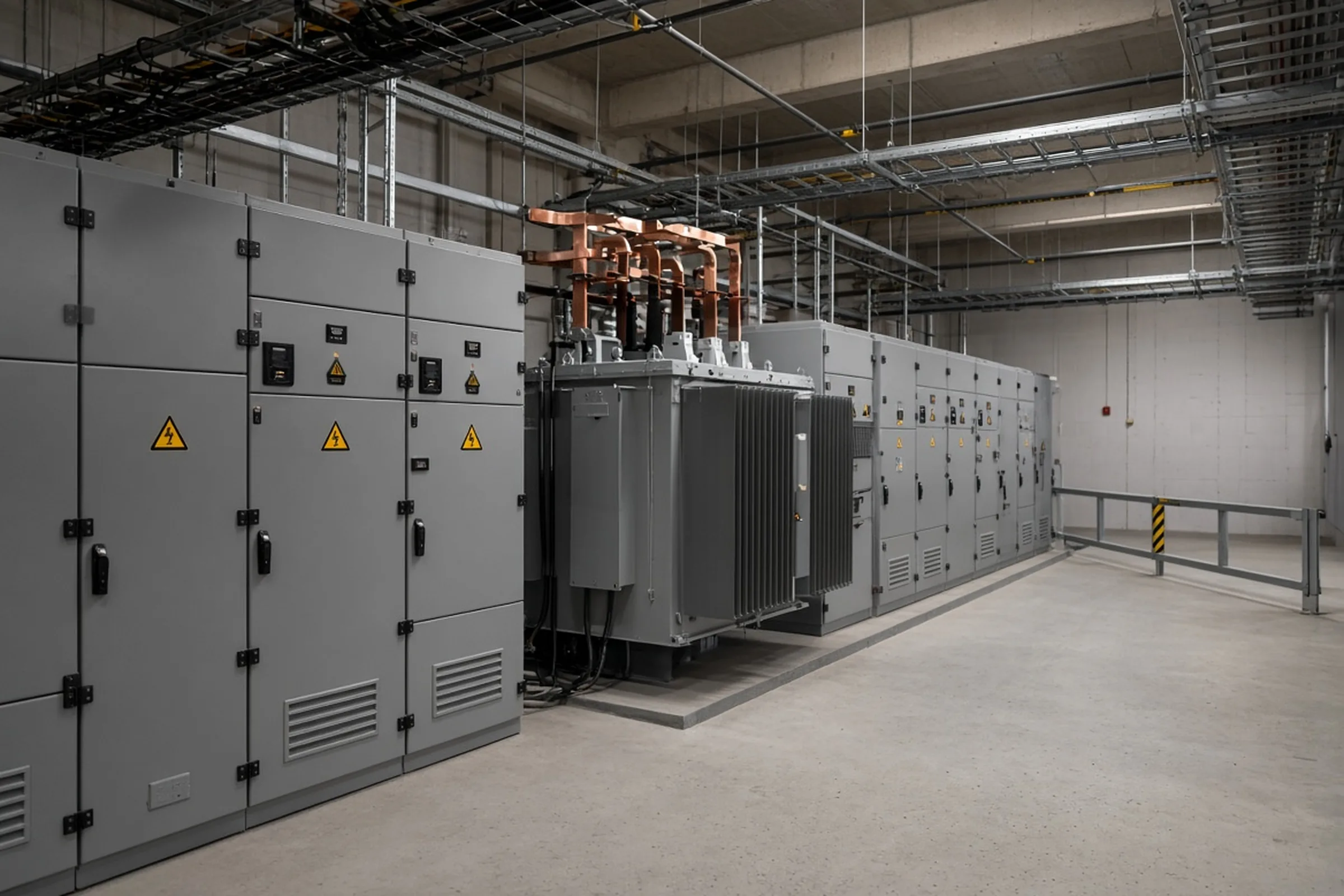
Switchgear + transformers

Illustrative reference — indicative ratings, not a site spec. Currents shown are order-of-magnitude for a 100 MW-class facility. Training-cluster power signatures grounded in published profiles (Uptime Institute, 2025); capacity-demand context from industry studies (McKinsey, IDC, Gartner). A Feasibility Study produces the bankable single-line and ratings for your site.

DETERMINISTIC · PHYSICS-INFORMED

Technology rooted in first principles.
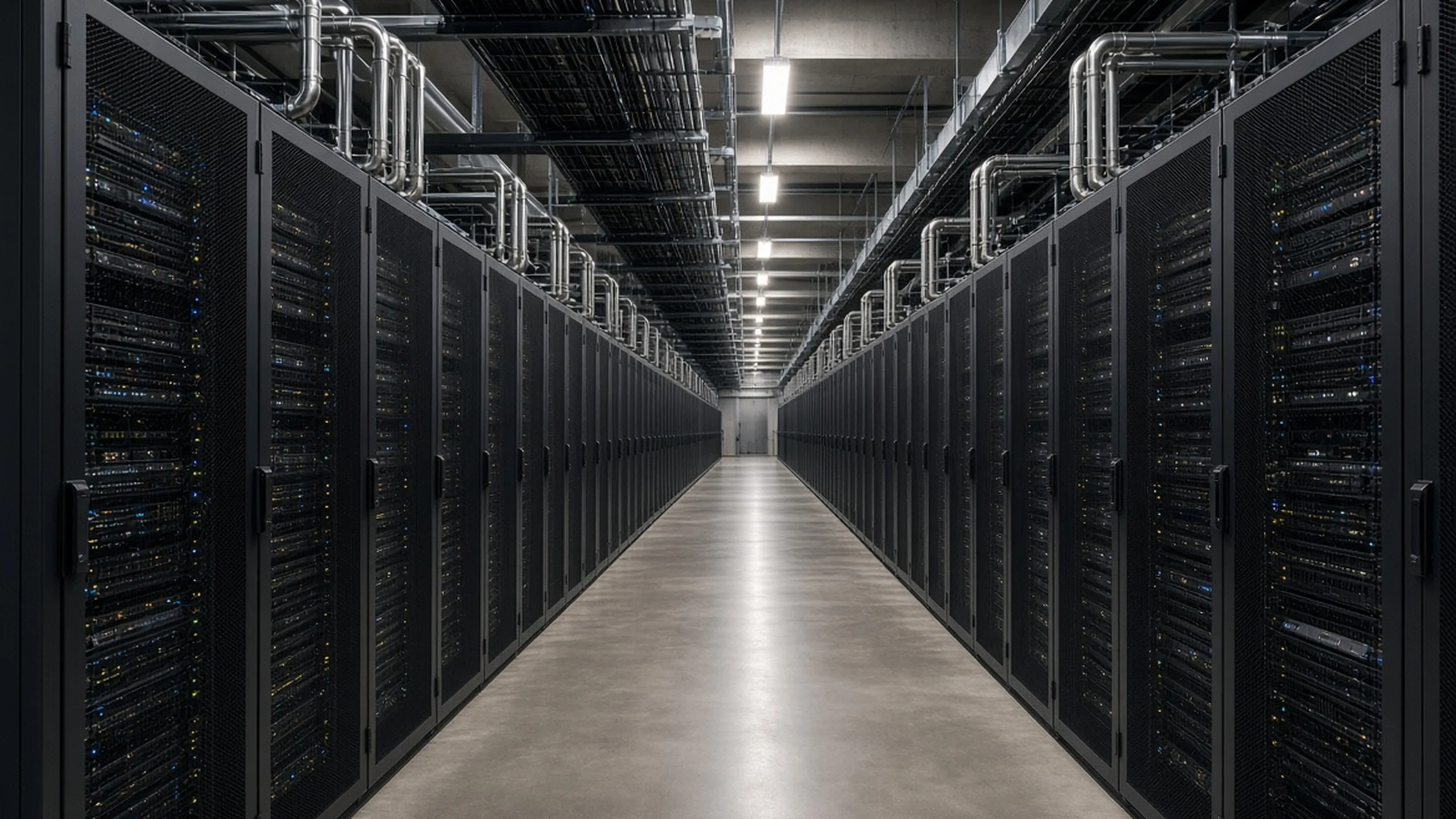
01

Hybrid microgrid architectures

Containerized hybrid topologies with DC-native coupling, designed around the load profiles of AI training and inference clusters — phased so capacity tracks the build-out.

02

Physics-informed control

Deterministic models that combine physics with real-time telemetry to forecast and respond to GPU power spikes — enabling genuine peak shaving rather than oversized headroom.

03

Second-life BESS integration

BMS and thermal-management approaches for retired EV packs that lower capex while holding round-trip efficiency and warranty-grade safety.

04

Founder-led engineering

Every design starts from first principles — power-flow physics and control theory — not a vendor catalog. Background in grid intelligence and cyber-physical systems.

FOUNDER-LED

Vincenzo Grimaldi

GridForge AI is the engineering practice of Vincenzo Grimaldi — a grid networks engineer working on the digitalization of high-voltage assets, with an M.Sc. from RWTH Aachen in cross-domain grid intelligence. The premise is simple: the AI buildout is gated by power, and the fastest path through it is deterministic, physics-informed engineering — not vendor catalogs.

DISCIPLINE
Power-systems engineering, grid intelligence, and deterministic control.
PRINCIPLE
Every design starts from power-flow physics and control theory — no black boxes.
STAGE
Pilot-stage and direct. Early partners work with the engineer, not an account manager.

Founder principles and prior work: igrimaldi.engineering

STRAIGHT ANSWERS

No overclaiming.

READY WHEN YOU ARE

Let's pressure-test your
time-to-power.

Send the site details. You'll hear back from the engineer within one business day.

No obligation · NDA on request · power@gridforge.ai